
A few years before the pandemic, I was recruiting for a head of HR role. I had headhunted the candidate, so I was selling. The company, the scope, the money. She listened. Then she told me something I have never forgotten.
Her employer let her close at one o’clock to pick up her child and work from home after. She said she could not move to any employer who would not offer her the same.
At the time, this was almost unheard of. Deep down, given my values, I believed it was a good benefit. But I still did not think it was worth mentioning to my client. I assumed it would not fly. I made a call on an assumption, which is the very thing I warn people against. Assumption is the lowest level of knowledge. Yet there I was, filling in the answer myself instead of asking the question. Something told me they would say no, so I never asked. We filled the role with someone else. But I believe we lost a good candidate that day. And I believe many firms are still doing the same, every day, on the strength of an assumption they never test.
You see, the standard working day was so fixed in my mind that a mother collecting her child looked like an awkward request, not a fair one.
I have thought about that conversation many times since. Why was that ever such a big deal? Why does it still feel like one?
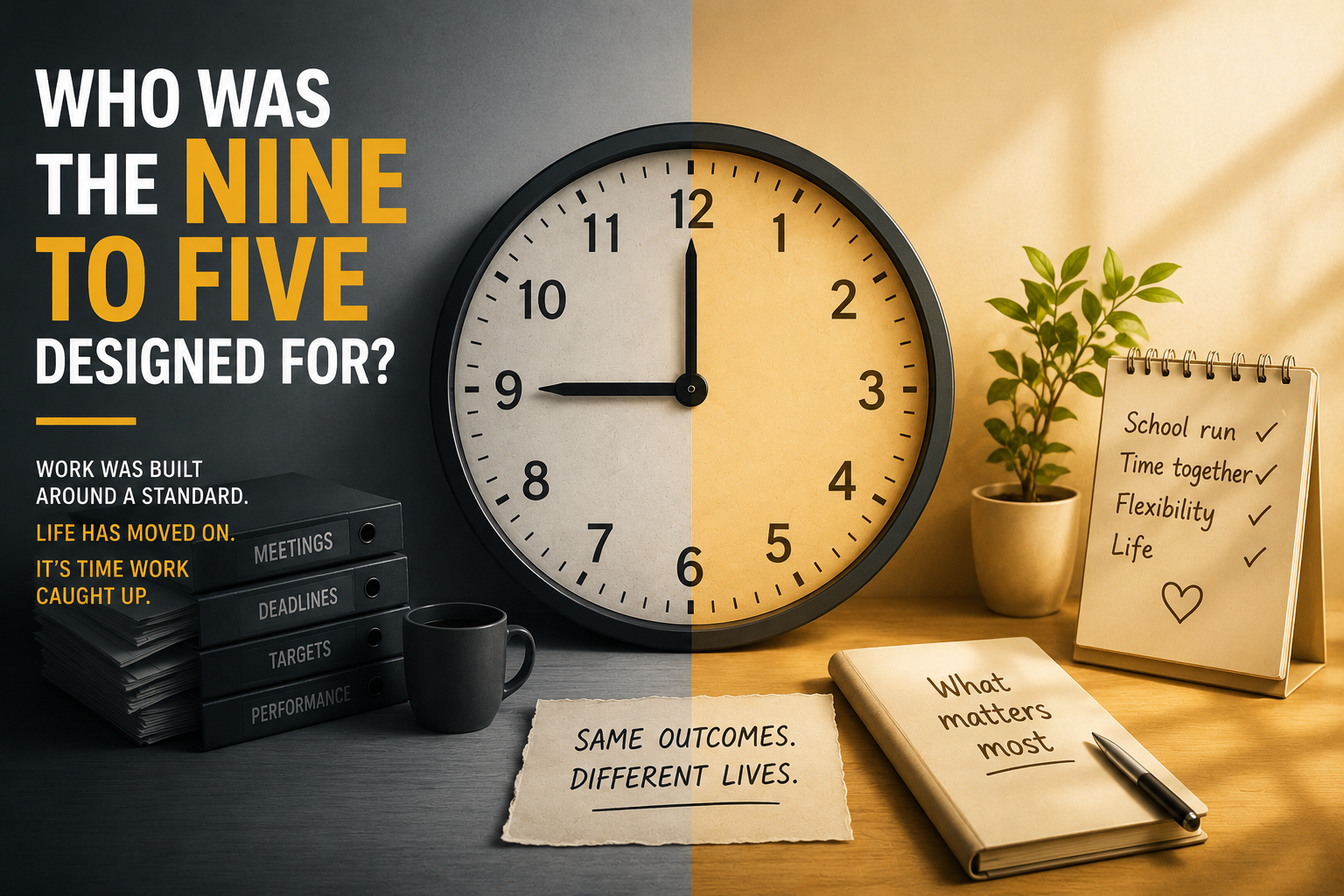
I see it differently now. We built work around a standard that was never designed for the people doing it. The nine to five has never matched the school day. It never has. It assumes a worker with no children to pick up, or someone at home to do it. And for a long time, that was true. There was usually someone at home. Often one earner, usually the man, and someone else; aspouse, a nanny, or hired help who absorbed everything the working day could not. The school run. The sick child. The errand that only happens in office hours.
That world has largely gone. Most homes today have every adult in paid work. Unless you are privileged, there is often no one left at home to carry the overflow. But the working day has barely moved. Wowrkplace have kept the standard and expect emeployees to sort out the support they need to keep a job.
That is why people ask for flexibility. They are not asking for a favour. They are pointing at a mismatch the rest of us agreed not to see.
Now let me be clear about what I am not saying.
I am not saying bend everything for everyone. I am not saying personalise every rule until there is no standard left. That will be chaos. Being flexible is not the same as customising everything. It is knowing what to hold firm and what to be flexible about, and having the wisdom to tell the difference.
So what is wise to standardise, and what is wise to personalise? I would say, standardise the things that hold the organisation together and keep it fair. The purpose. The values. The standard of performance. The outcomes people are accountable for. These should be the same for everyone. Not negotiable.Personalise the things that depend on the person. How, when and where they do the work. And the benefits that actually matter at their stage of life.
Take two people in the same role. One is a parent who must pick up a child at 3pm. The other joined last year and wants time in the office to learn from the people around her. Hold them to the same outcome. Same targets, same quality, same deadlines. That part does not move. But let the parent work a shifted day and finish in the evening. Let the joiner come in four days a week for the mentoring she is looking for. Same accountability. Different shape. Neither is a favour.
Now think about benefits. A benefit only has value if it is used. A benefit no one uses is just cost. I have watched organisations spend good money into things half their people never touch, all in the name of fairness. Gym memberships the young use and parents do not. After work drinks that reward the people with nothing to rush home to, and leave out everyone who does. One health plan that covers what many will never need and misses what others urgently do.
Every one of these is defended as fair because it is the same. But it is not fair. It is money going to what people do not want, and away from what they do.
Let people choose what fits their life and you often spend the same or less, and get far more. Because every pound spent lands where it is actually valued. So this is what I have come to believe about fairness. Fairness is not giving everyone the same thing. It is giving everyone something of equal value to them. And that will look different for different people.
My research says the same. I interviewed people about what kept them engaged working remotely. What came out strong was the lifestyle benefit. The most engaged were the ones truly gaining from what flexible work gave them. Time back from the commute. Comfort. A working life that fit their own life. Engagement was not bought with free lunches and games rooms, it increased when work fit a person’s life.
That candidate understood this before I did. She knew what she needed, and she was not willing to go backwards for a title.
So I would ask leaders a different question from the one they keep arguing over. Not how do we get people back to the office. Not how flexible should we be.
The real question is this. Have you actually decided what your organisation must hold firm for everyone, and what it should shape around the person? Or is that being decided by habit, by whoever shouts loudest, by whatever you did last year?
The organisations that keep their best people will not be the most flexible or the most rigid. They will be the wisest. The ones that knew what to standardise, knew what to personalise, and had the sense to tell them apart.
That candidate knew what she needed, and she would not go backwards for a title. I never asked my client the question. I still wish I had. So ask it. Test the assumption. The good candidate you lose based on assumption is the one a wiser firm will keep.
So, on flexibility, what should you standardise and what should you personalise, that is the question.
Your thoughts?


0 Comments